
Revolutionising
Manufacturing
Inspection
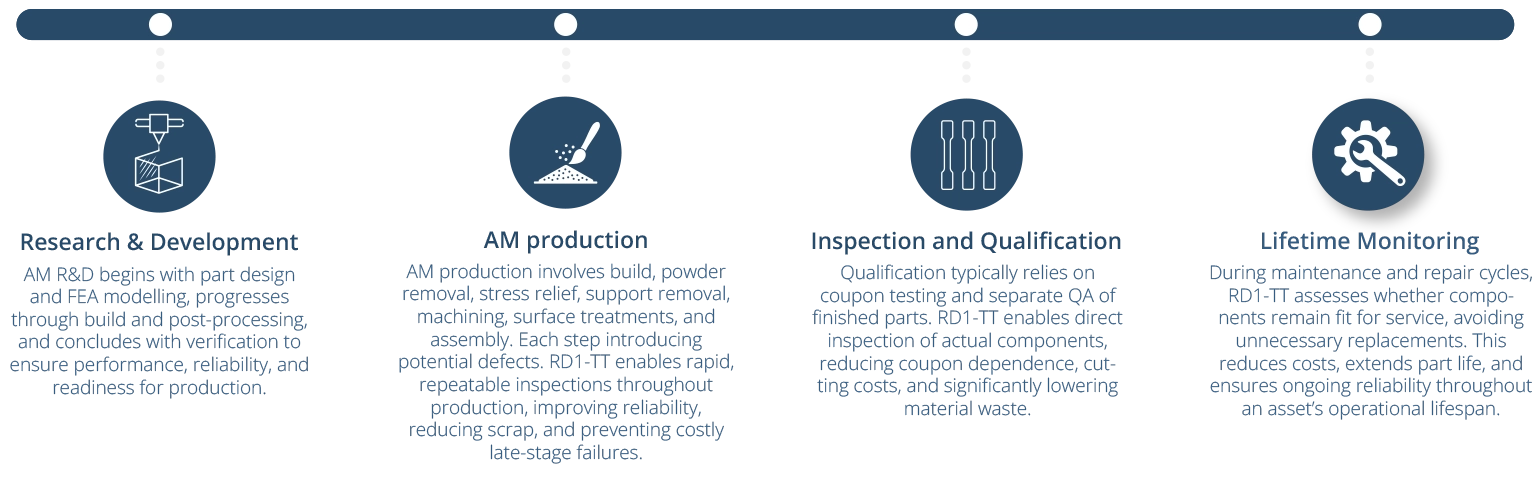
Validate complex metal AM parts faster, with greater accuracy, and with complete confidence with Theta Technologies’ innovative nonlinear resonance non-destructive evaluation technology.
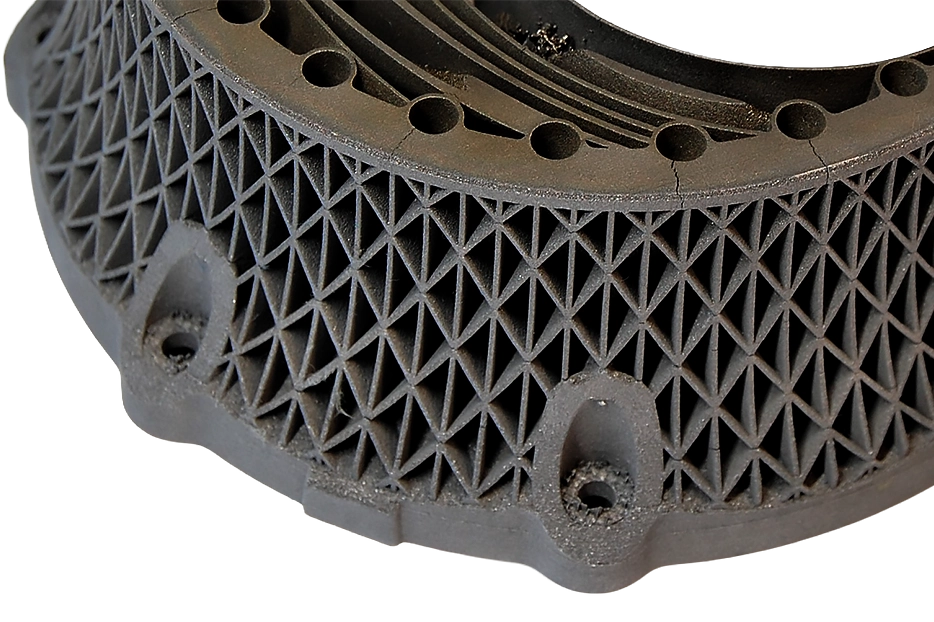

Meet RD1-TT, the
inspection solution for
Additive Manufacturing
Designed for rapid, reliable non-destructive evaluation: From research labs to production floors, RD1-TT fits seamlessly into your existing manufacturing workflow to facilitate faster part inspection. No longer will you need to invest in expensive X-ray CT equipment, or ship AM parts off-site for validation, thanks to this cost-effective NDE technology.

Key Enablers of
Nonlinear Resonance NDE

Faster Part Inspection
Nonlinear resonance NDE enables the rapid inspection of parts in minutes rather than hours, allowing manufacturers to detect critical defects earlier in the process, reduce bottlenecks, and accelerate qualification without compromising sensitivity or reliability.

Self-referencing NDE
By comparing a part’s dynamic response to itself rather than an external standard, nonlinear resonance NDE removes the need for reference samples, simplifying inspection, reducing setup time, and improving consistency across batches and production runs.

Geometry Agnostic
Unlike many conventional methods, nonlinear resonance is unaffected by complex geometries, thin walls, or internal structures, making it ideal for inspecting advanced additive-manufactured components that are otherwise difficult to assess reliably.

Low Cost NDE
Nonlinear resonance lowers inspection costs by eliminating expensive consumables, radiation shielding, and lengthy scan times, delivering a cost-effective route to high-sensitivity defect detection without sacrificing throughput, safety, or reliability.
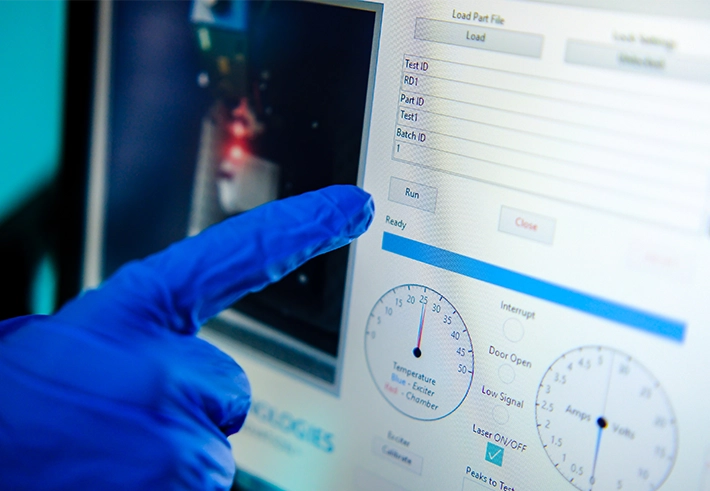
Non-Destructive Evaluation
that actually works
Additive manufacturing demands inspection methods that can keep pace with complex geometries, rough surface finishes, and hidden sub-surface flaws. Nonlinear resonance NDE was developed specifically for these challenges, providing a practical, high-sensitivity way to detect critical defects that traditional methods often miss. By focusing on how parts behave rather than how they look, it delivers reliable, repeatable inspection for real-world AM components, helping manufacturers qualify parts faster, reduce risk, and build confidence in performance.
AM Part Qualification
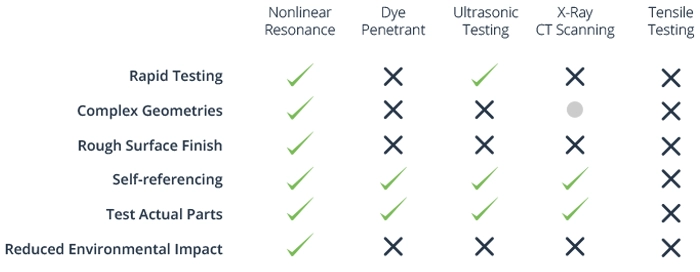
techniques compared
With a plethora of testing techniques available, how do you know which one is best suited for your AM production requirements? See how nonlinear resonance compares to some of the more conventional testing methods when faced with AM parts.

Start a conversation
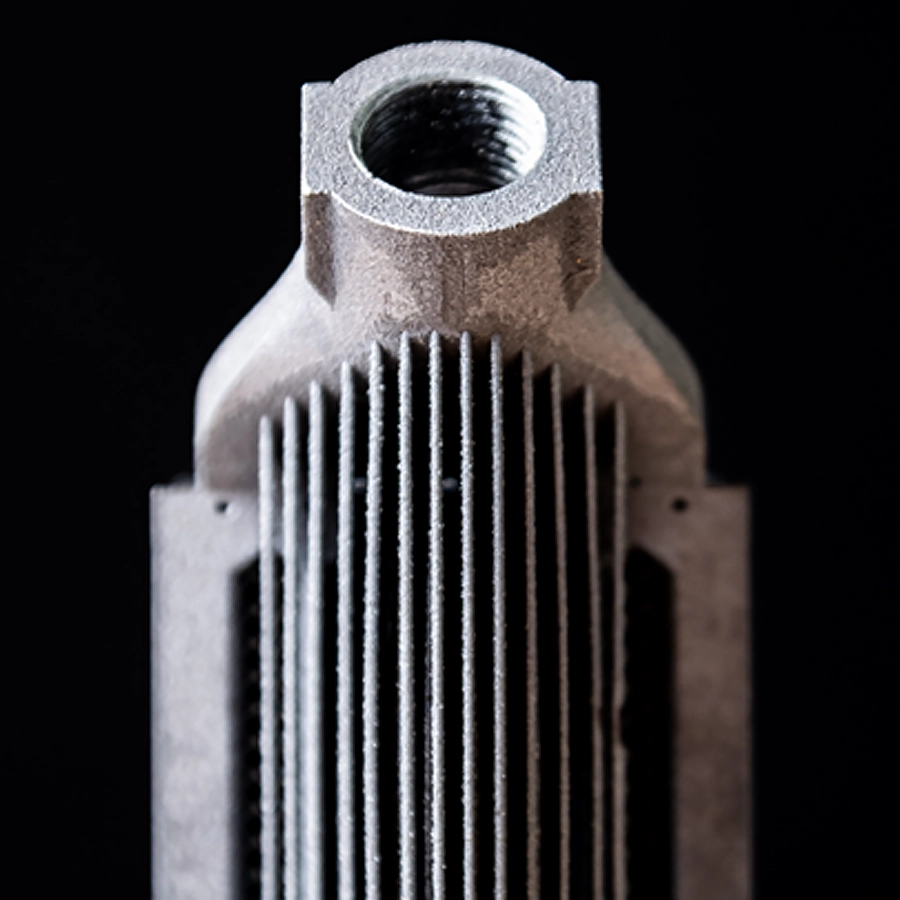
The solution for
your AM challenges
From bottlenecks created by time-intensive processes to increased waste due to testing late in the process, AM part validation has proved challenging for traditional NDE methods.
Increasing design flexibility on offer with AM has also caused complications. Complex lattices, internal voids, and unconventional shapes reduce the effectiveness of conventional NDE, which often miss subtle internal defects. This makes them inefficient and unreliable for advanced AM components.
Reinvent your
in-house AM workflow
Integrate nonlinear resonance testing at any stage of your manufacturing process. From the initial build, post-processing, or final sign-off, RD1-TT enhances your current inspection workflow; reducing delays while improving defect detection and part confidence.

A nonlinear resonance
part inspection test explained
See a nonlinear resonance non-destructive test in action as our very own Applications Engineer, Lydia takes you through a thorough step-by-step guide.
How it works
Every part has a unique resonant signature (like a fingerprint). When internal flaws or micro-cracks exist, that signature shifts. RD1-TT detects those subtle responses, pinpointing structural integrity without cutting, scanning, or guesswork.

Mount part in fixture
Place your AM component into a bespoke fixture within RD1-TT for maximum reliability.

Conduct acoustic test
The AM component is excited into resonance using varying amplitudes to identify flaws within.
Analyse results
Our advanced software algorithm checks for changes in frequency responses that highlight flaws.

Nonlinear metrics
Results of tests are plotted in the form of a ‘damage index’ helping to reveal inconsistencies.
60 Seconds
Nonlinear Resonance
‘Damage Index’ Results Data
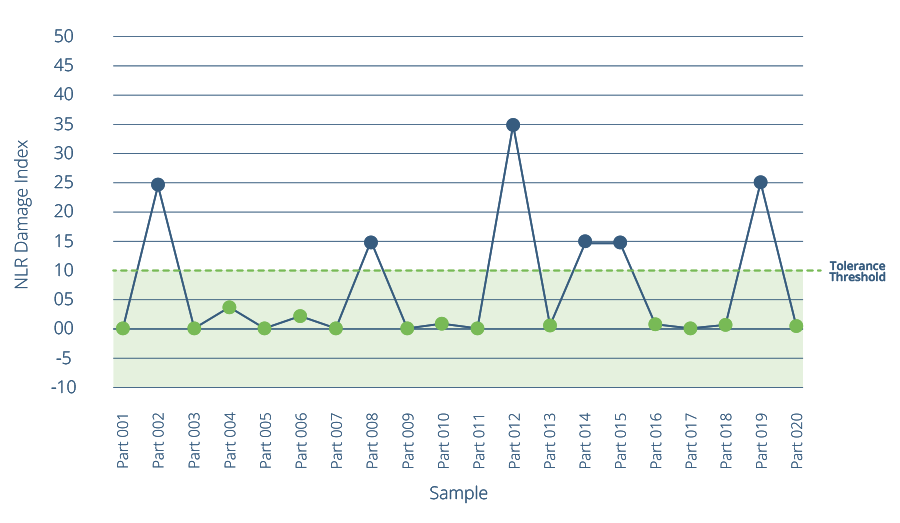
Results of individual tests are plotted in the form on a ‘damage index’ which helps to reveal parts of concern. Nonlinear resonance provides a figure of merit related to the number of flaw indications in the different acoustic signature of the parts under test. This does not categorically state whether a part is fit for its intended purpose or not, it simply highlights the parts at risk of failing in service.
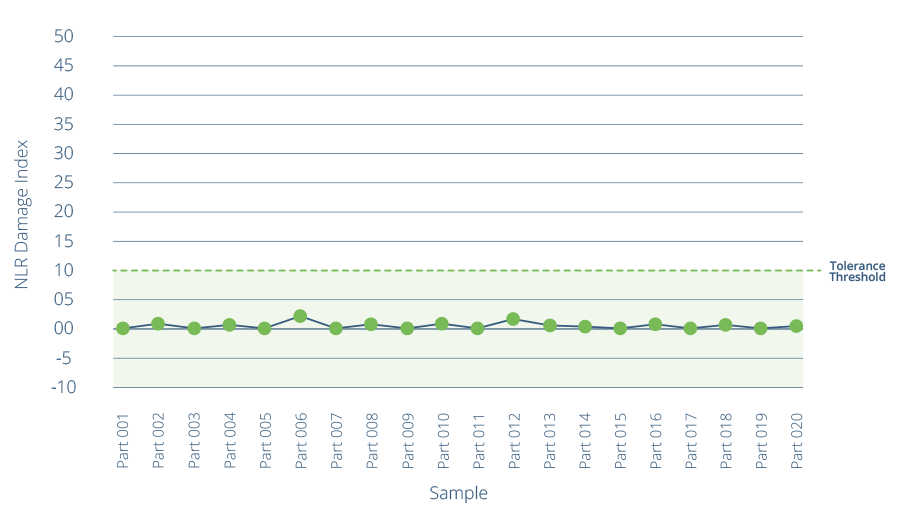
NLR Results Example
Flaw-Free Production
All parts tested in this set show no or minimal signs of nonlinearity and fall below the tolerance threshold deemed acceptable by the customer. These results do not reveal the presence of defects within the batch.
To find out more about nonlinear resonance NDT or to discuss your NDT requirements in detail, book a meeting with our team.
NLR Results Example
Flawed Production
The nonlinear resonance test results for this production batch reveal a number of parts with high nonlinearity. Parts 002, 008, 012, 014, 015 and 019 exceed the tolerance threshold for nonlinearity and would pose potential risk if used for their intended application.
Your Questions Answered:
What parts can you test?
Nonlinear resonance NDE is suitable for a wide range of parts made from a variety of materials including: Metals, AM metals, ceramics, most composites, and hard plastics (filled PEEK/PAEK). There is no limit on part complexity or surface roughness requirement.
What size of part can you test?
Max: 600 x 450 x 300 mm/ 24 inch x 18 inch x 12 inch maximum in RD1-TT.
If your parts are larger than this, we’d be happy to discuss testing on our internal test systems. Please get in touch.
Is nonlinear resonance just for AM parts?
No, if we can energise the part sufficiently, we can test it. To date, we’ve experience in successfully testing Metals, Ceramics, Fibre composites, Ceramic composites, Hard plastics (Filled PEEK/ PAEK).
We can also test traditionally manufactured parts, castings, and forgings
How long does a test take?
For a fully optimised production test, we can test parts in around 1 minute.
For more detailed assessments or engineering/ R&D applications, 5 – 10 minutes is common.
What flaws can nonlinear resonance NDE identify?
Nonlinear resonance is best suited to contact cracks, volumetric cracks, lack of fusion, disbond, delaminations, dislocations (crystallographic flaws).
This technology is less suited to Voids, Seeded defects (EDM slots, holes) Porosity – though we do have methods of detecting these. Please do get in touch to discuss your individual requirements.
Talk to
Our Team of
Technical Specialists
Connect with our team of technical experts today and explore how RD1-TT can help revolutionise your additive manufacturing processes.
Theta Technologies Limited

Address
Theta Technologies Limited
3 Babbage Way
Exeter Science Park
Clyst Honiton
Exeter
EX5 2FN
United Kingdom
Terms & Conditions Privacy & Cookie Policy Anti-Slavery Policy © Theta Technologies. 2026